
English| EUR
Suggested for you
More currencies
Choose a language
Most visitors reach the upper mountain by Teleférico; a much smaller number walk. The ascent on foot from Montaña Blanca is a different proposition entirely — a long, exposed climb through the Las Cañadas caldera to the highest ground in Spain. This page sets out what actually controls the timing, and where the summit permit sits in the sequence.
Quick answer
Walking up Teide is a full-day commitment rather than a short detour: the Montaña Blanca trail climbs from the caldera floor to the 3,715 m summit cone and is normally begun in the morning. Parque Nacional del Teide is open 00:00–23:59 every day, so daylight, altitude and the separate summit permit — not gates — set the schedule. Aim to arrive between 09:00 and 11:00.
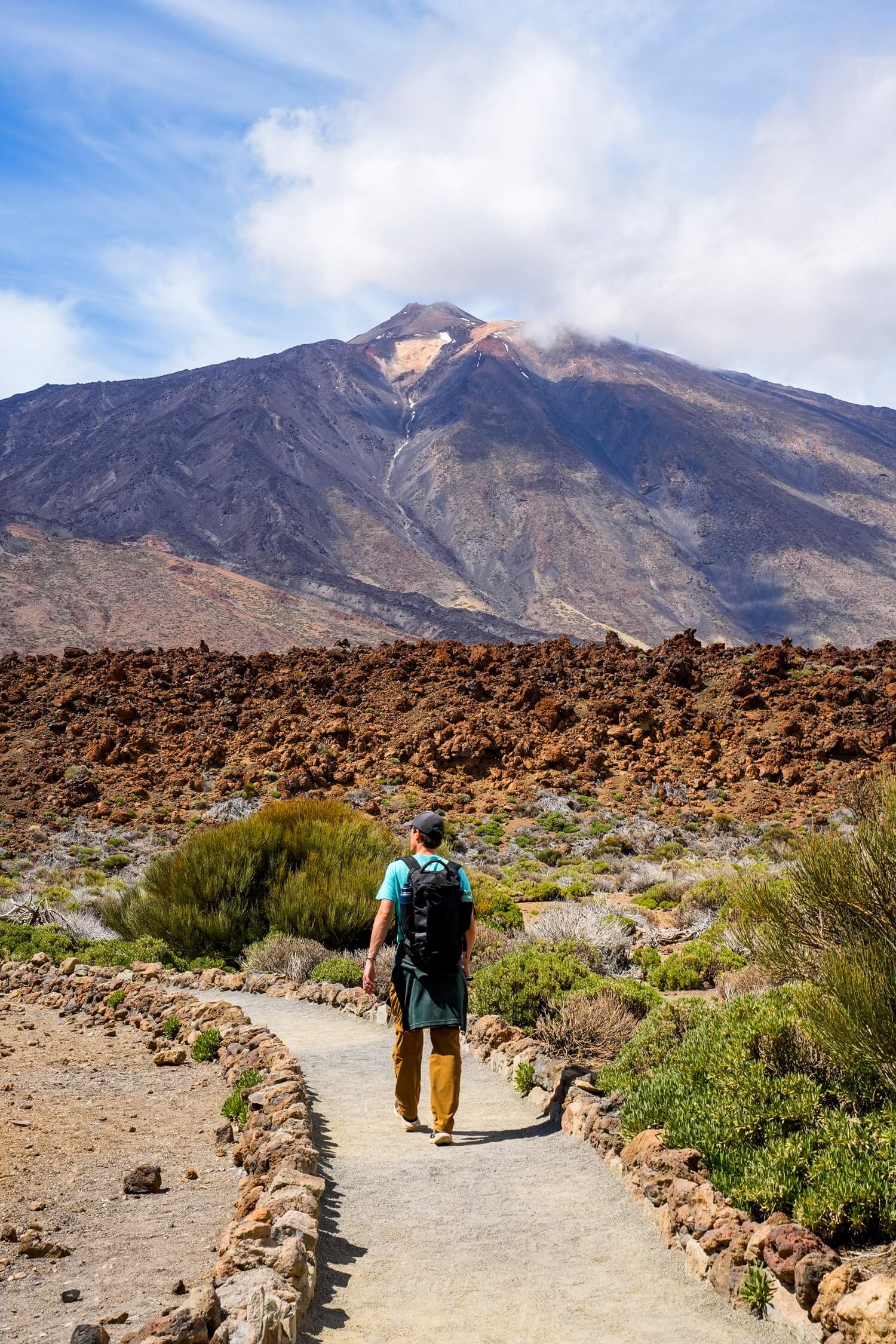
The final cone of Teide is the only stretch of the mountain that requires written permission to stand on. Everything beneath it — the Montaña Blanca trail, the mineral scree of Las Cañadas, the old lava flows running toward Pico Viejo — is walked freely, inside a national park carrying UNESCO World Heritage status. That split explains why how long does it take to walk up Teide is rarely answered with a single number: the route is effectively two journeys, one open to anyone with the legs for it, the other rationed by permit and by the operating window of the Teleférico. The climb is unusual among European ascents because almost none of it is technical. There is no scrambling, no exposure, no real navigation problem. What there is instead is altitude. Walkers who move easily at sea level find their pace halving somewhere above the Refugio de Altavista, and it is the thin air, not the gradient, that stretches the day. Subida al Teide a pie is therefore a question of acclimatisation as much as fitness. The volcanic surface compounds it: loose pumice and clinker return less energy with every step, and the descent runs slower than most people budget for. Context matters for the planning. The mountain sits inside a caldera reached only by mountain road, so the walk is bracketed at both ends by driving, and the park itself never shuts even though daylight and the cable car do. Most walkers treat the ascent as a fixed commitment rather than a flexible outing, then build the rest of the Tenerife itinerary around it — the Roques de García loop below, the viewpoints along the TF-21, an evening under some of the clearest skies in the northern hemisphere. Use the sections further down for the specifics: the hour-by-hour breakdown, the permit sequence, the seasonal notes and the kit list each sit in their own place. Read together, they turn how long does it take to walk up teide from an abstract figure into a decision — whether to walk both directions, or climb on foot and ride back down.
“It is the thin air, not the gradient, that stretches the day.”
This timeline suits a reasonably fit walker doing the classic Montaña Blanca ascent to La Rambleta, with the optional Pico del Teide summit leg on a booked permit slot; budget roughly 8 to 10 hours on foot for the full return, or around 6 hours if you descend by cable car. Arriving in the 09:00–11:00 window keeps the long open stretch cooler and less busy.
Park at the trailhead on the TF-21 and set off on Sendero 7. The first 4 km of graded track to the Huevos del Teide gains height gently, so expect 1 to 1.5 hours here.
The gradient steepens on loose volcanic scree above the Huevos, and pace typically drops to 2 km/h or less. Allow 2 to 3 hours for this stretch, drinking steadily as the air thins past 2,700 m.
Most walkers pause 20 to 40 minutes here at 3,270 m to eat, refill and let breathing settle. Those staying overnight stop for the day; day walkers push on.
A further 1 to 1.5 hours over the Mirador de La Fortaleza lava fields brings you to La Rambleta at 3,555 m. Wind is usually strongest on this exposed traverse.
The Telesforo Bravo path to the 3,715 m crater rim takes 25 to 40 minutes up and back, but only within your booked permit slot. Miss the slot and you walk to La Rambleta only.
Walking down retraces the same route in 3 to 4 hours; taking the cable car instead cuts this to minutes. Whichever you choose, be moving before mid-afternoon so you are not on scree in fading light.
The Teide walking access schedule is simple: the trail access system runs every day of the week, with no weekday closures. For planning purposes, use the official hourly windows rather than assuming a single all-day entry rule.
This sequence covers the administrative and on-trail steps for walking to the summit of Mount Teide, from securing the permit to descending within the authorised window. Treat it as a compliance checklist that runs alongside your walking plan rather than a substitute for it.
Apply through the official reservation system at https://www.tenerifeon.es/en/general-information/rules/ascent-on-foot-of-mount-teide well ahead of your trip, because the free permit for the final cone above the cable car station is capped daily and often gone weeks in advance. The permit is issued to a named person with a fixed time slot, and staff at the checkpoint will ask for both the printed or digital permit and matching photo ID.
Confirm on the national park site that your chosen route is open on the day, as high winds, snow, ice or volcanic monitoring work close individual paths at short notice. People often check only the weather forecast for the coast, which bears little relation to conditions at altitude.
Plan your start so you reach the trailhead in the 09:00–11:00 arrival window for cooler weather and fewer visitors, allowing for the drive up and parking. The park itself is accessible monday to sunday, 00:00–23:59, but your permit slot is not, and arriving late forfeits it.
Non-resident visitors pay an entrance fee of 25 EUR (ecotasa for non-resident visitors); keep the confirmation accessible on your phone or on paper. Wardens check this separately from the summit permit, so having one does not cover the other.
Walk your chosen route to the Rambleta hut area, where the guarded gate to the final cone sits. Present your permit here rather than at the trailhead, and expect a short queue if several slots overlap.
Begin the descent so you clear the summit cone before your permit window closes, and note the last cable car departure if you intended to ride down. Walkers who miss it face a long descent on foot in falling light.
A few preparations made in the right order keep the walk on schedule rather than adding unplanned delays.
Mount Teide’s ascent on foot is a strenuous high-altitude walk on mountain trails, so it is not a casual or step-free route. Accessibility is limited by uneven terrain, altitude, and the need to use designated trails under official park rules.
The ascent on foot is not suitable for wheelchair users because it follows mountain trails with irregular ground.
No step-free walking route is indicated for the ascent.
There are no lifts for reaching the walking route.
No official accessible-toilet provision is stated for the trail access area.
No hearing or visual assistance features are listed for visitors on this route.
Everything you need to know about how long does it take to walk up teide
For the classic hike, Tenerife ON’s trail guidance uses estimated completion time without stops, and the climb is treated as a high-effort mountain route. The exact walking time depends on your pace, altitude response, and whether you stop often, so the official site’s duration method is the safest baseline for planning.
From Montaña Blanca, how long does it take to walk up teide depends on the trail segment you choose and how you handle the ascent, but the route is long enough that Tenerife ON recommends using its duration estimates rather than guessing. The altitude makes the effort harder than a normal hillside walk, so allow extra margin for a slow pace or photo stops.
Yes, access is regulated on several summit routes, including PNT 07 Montaña Blanca – La Rambleta, and a prior reservation is required for the controlled sections. The official Tenerife ON page for the ascent explains that the booking is part of the safety rules for walking up the mountain.
The official entrance fee is 25 EUR for non-resident visitors, described as an ecotasa. That fee is the figure to use on this information page, and it should not be mixed with any separate transport or guide costs.
Walking up Teide with children is only sensible for families used to steep volcanic trails and long mountain efforts. The route is exposed, the terrain can be demanding, and you should judge it by the child’s hiking experience rather than by age alone.
The best arrival window is 09:00–11:00, when conditions are usually cooler and visitor numbers are lower. If you are planning how long does it take to walk up teide, starting in that window also gives you more daylight and less heat stress on the ascent.
The Teide access rules are in force every day of the week, and the official opening hours listed for this page run 00:00–23:59 from Monday through Sunday. That means timing is governed more by reservation rules, weather, and trail control than by a simple daily closure.
Tenerife Teide Stargazing Tours
Read more Tickets & toursTeide Astronomy Tours
Read more GuideHow to Stargaze in Tenerife on Your Own
Read more GuideBest Teide Stargazing Tours
Read more GuideCan You See Stars When It Rains?
Read more Tickets & toursSunset & Stargazing Tours
Read more Tickets & toursPrivate Stargazing Tours
Read more