
English| EUR
Suggested for you
More currencies
Choose a language
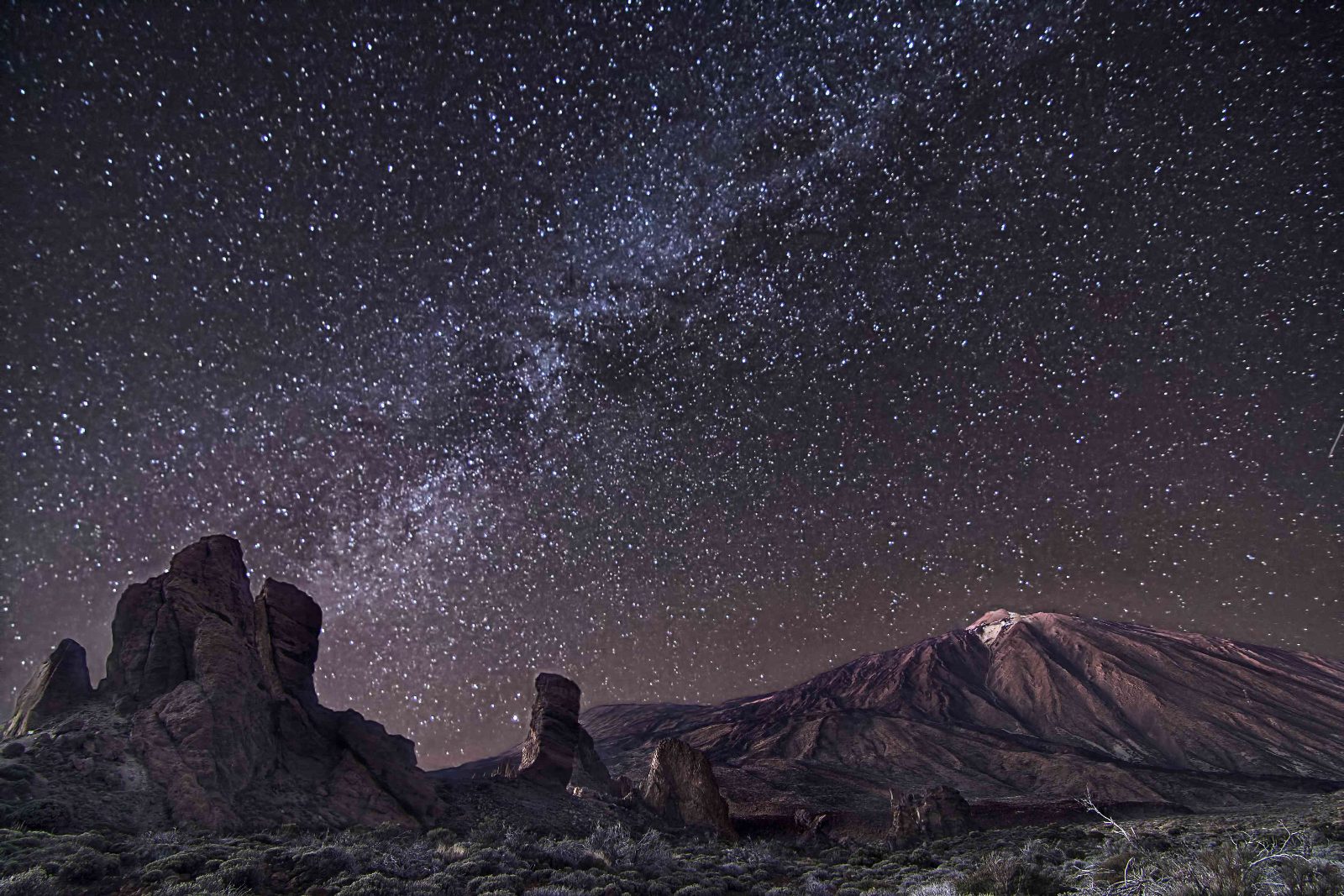
Above 2,000 metres, Tenerife's peak sits over the inversion layer that traps cloud on the coast below. That single geographic accident is why the Teide summit ranks among the clearest observing sites in the northern hemisphere. This page explains what a night on the mountain actually involves, and which details decide whether it is worth the drive.
Quick answer
Teide National Park itself never closes — the park is open 00:00–23:59, seven days a week — so night access is unrestricted, though a 25 EUR access fee applies to non-residents on trails 7 and 10. The limits are practical rather than administrative: no lighting, sub-zero winter temperatures at altitude, and moon phase, which matters more than any operator's itinerary.
The Instituto de Astrofísica de Canarias has monitored the skies above this island since the 1970s, and the reason is measurable: the trade-wind inversion layer pins a sea of cloud at roughly 1,500 metres, leaving everything above it in dry, still air. Anyone comparing options for the best teide stargazing tour is really comparing altitude, moon phase and cloud probability — the three variables that decide whether the Milky Way appears as a smear or as structure. Tenerife's summit region is protected by the Sky Law of 1988, which restricts light pollution across the island, and the whole area carries UNESCO World Heritage status alongside its Starlight Reserve designation. What the reader is actually dealing with is a high-altitude desert at night. The caldera floor of Las Cañadas sits near 2,100 metres; the Teleférico base station is higher still. Temperatures drop sharply after sunset year-round, and in August 2026 a warm coastal evening in Puerto de la Cruz can still mean single figures at the Roques de García. Excursión nocturna al Teide operators account for this with parkas and hot drinks, but independent visitors frequently do not. The road network — the TF-21 and TF-24 — is unlit and winding, which is the practical argument for a guided Mount Teide night tour over a self-drive attempt. The second variable is the calendar, not the clock. New moon weeks deliver the darkest skies; a full moon washes out all but the brightest objects, though it lights the lava fields well enough for landscape photography. Guided groups typically pair a telescope session with a laser-pointed constellation tour, and the better ones brief on the Pico Viejo and Montaña Blanca formations underfoot before turning attention upward. Use this page as a best teide stargazing guide to the decision, not the transaction. Check the moon calendar first, confirm the weather at altitude rather than at sea level, and then compare what each operator includes — transfer, equipment, guide language. Booking pages elsewhere on this site list current availability, and the parallel Teide sunset excursion pages cover daylight timing for those combining both. A well-chosen best teide stargazing tour rewards the effort; a badly timed one delivers cloud.
“The sea of cloud sits at 1,500 metres. Everything above it is observing weather.”
Teide National Park sits high in central Tenerife, in a remote volcanic landscape that takes planning to reach comfortably for a stargazing tour. The main access point is the Teide National Park area in Tenerife, Canary Islands, Spain, with the park roads feeding into the high-altitude trail and viewing zones.
TF-21 Las Cañadas del Teide road to Teide National Park
TF-24 or TF-21 via La Orotava/Portillo approaches to the park area
Titsa interurban bus to the Teide area, then transfer locally as needed
Direct taxi to Teide National Park / the tour meeting point
Because this is a high-altitude mountain area, build in extra time for parking and slower road conditions. If your booking or pickup uses a specific park meeting point, follow that exact entrance and arrive early enough to settle in before the tour starts.
Teide National Park is open every day of the week, so night-sky visits and overnight planning can be arranged without a weekday closure to work around. The schedule below is published for all seven days and stays the same throughout the week.
This sequence takes a first-time visitor from confirming what access permissions they need through to following the guide's instructions at the observing site, and the planning side takes roughly an evening of admin spread over the weeks before the trip. On the day itself, the on-site portion runs from meeting point to departure in a single session.
Check whether your chosen route needs a separate access permit, since the peak path above the cable car station and the national park's marked trails are governed by different systems. Most people discover too late that a stargazing booking does not automatically include permission to walk the restricted upper trails.
Secure your spot through the booking pages on this site well before your travel dates, because night departures run limited group sizes and fill first in clear-sky periods. Note the exact tour name on your confirmation, as operators run several formats that leave from different points.
Enter each participant's name exactly as it appears on the passport or ID card they will carry. Staff check names against the manifest at the meeting point, and a nickname or reversed surname order is enough to hold up the whole group.
Contact the operator to verify the meeting point and departure time, since cloud cover, high wind, or calima can move or cancel a night session at short notice. Ask what the rescheduling policy is at the same time.
Reach the meeting point inside the window your confirmation specifies rather than at the departure time itself. Vehicles leave on schedule to reach altitude before full darkness, and latecomers are not waited for.
Switch phone screens and torches to red light or off once the group reaches the observing spot, and stay on the marked ground your guide indicates. White light ruins night vision for everyone present and takes about twenty minutes to recover from.
Review https://www.tenerifeon.es/en/facilities/overnight-bivouac-area/teide-area-authorised-for-overnight-stays-in-a-bivouac before you travel for current access conditions, especially if you intend to stay overnight in the bivouac area rather than descend with the group.
Run through these checks in the weeks and days before your night on Teide, so nothing derails the ascent once you are above the cloud line.
Everything you need to know about best teide stargazing tour
The best teide stargazing tour is usually one that combines clear-sky viewing with simple logistics, especially if you want to avoid rushing around Mount Teide. For many visitors, the easiest option is a guided evening visit that handles timing and access while you focus on the sky, the volcanic landscape, and the night views.
For a best teide stargazing tour, access rules matter because parts of Teide National Park use controlled trails and reservations. The official bivouac area on Mount Teide is tied to the PNT 07 Montaña Blanca–La Rambleta trail and requires a prior booking, so check the exact access conditions before you go.
The only fee stated in the official facts for this area is 25 EUR, described as an access fee for non-residents on trails 7 and 10. If you are comparing options for the best teide stargazing tour, do not assume extra tiered pricing from the information page itself.
For the best teide stargazing tour, the best arrival window is 06:30–08:30, when dawn views are stronger and crowds are lighter. If your plan includes night viewing, treat this as a logistics cue for the site rather than a change to the park’s own access rules.
The best teide stargazing tour can work for families, but the mountain setting is demanding and conditions can change quickly at altitude. The official Teide bivouac guidance notes cold, wind, strong sun, and large temperature swings, so children should only come if they are prepared for mountain conditions.
Public transport is possible for a best teide stargazing tour, with TITSA lines 341 and 348 serving the Teide area. The official Teide bus stop on line 348 is Parador de Turismo, and line 341 also serves stops within the park, so check current timetables before traveling.
Bring warm layers, mountain footwear, water, energy food, and a torch or flashlight for a best teide stargazing tour. The official bivouac guidance also says tents are forbidden, so your gear should stay lightweight and suitable for open-air mountain conditions.
Tenerife Teide Stargazing Tours
Read more Tickets & toursTeide Astronomy Tours
Read more GuideHow to Stargaze in Tenerife on Your Own
Read more GuideHow Long Does It Take to Walk Up Teide?
Read more GuideCan You See Stars When It Rains?
Read more Tickets & toursSunset & Stargazing Tours
Read more Tickets & toursPrivate Stargazing Tours
Read more